



Bordered vs borderless number plates can look surprisingly different once fitted to a car. Borderless plates give the background a cleaner, uninterrupted appearance, while a border frames the registration and adds definition around the edge.
Neither treatment is automatically the better-looking choice. The right design depends on the vehicle, surrounding trim, plate recess and character style. A border that complements one car can add unnecessary visual detail to another.
Here is what to consider before choosing yours.
What Is the Difference Between Bordered and Borderless Number Plates?
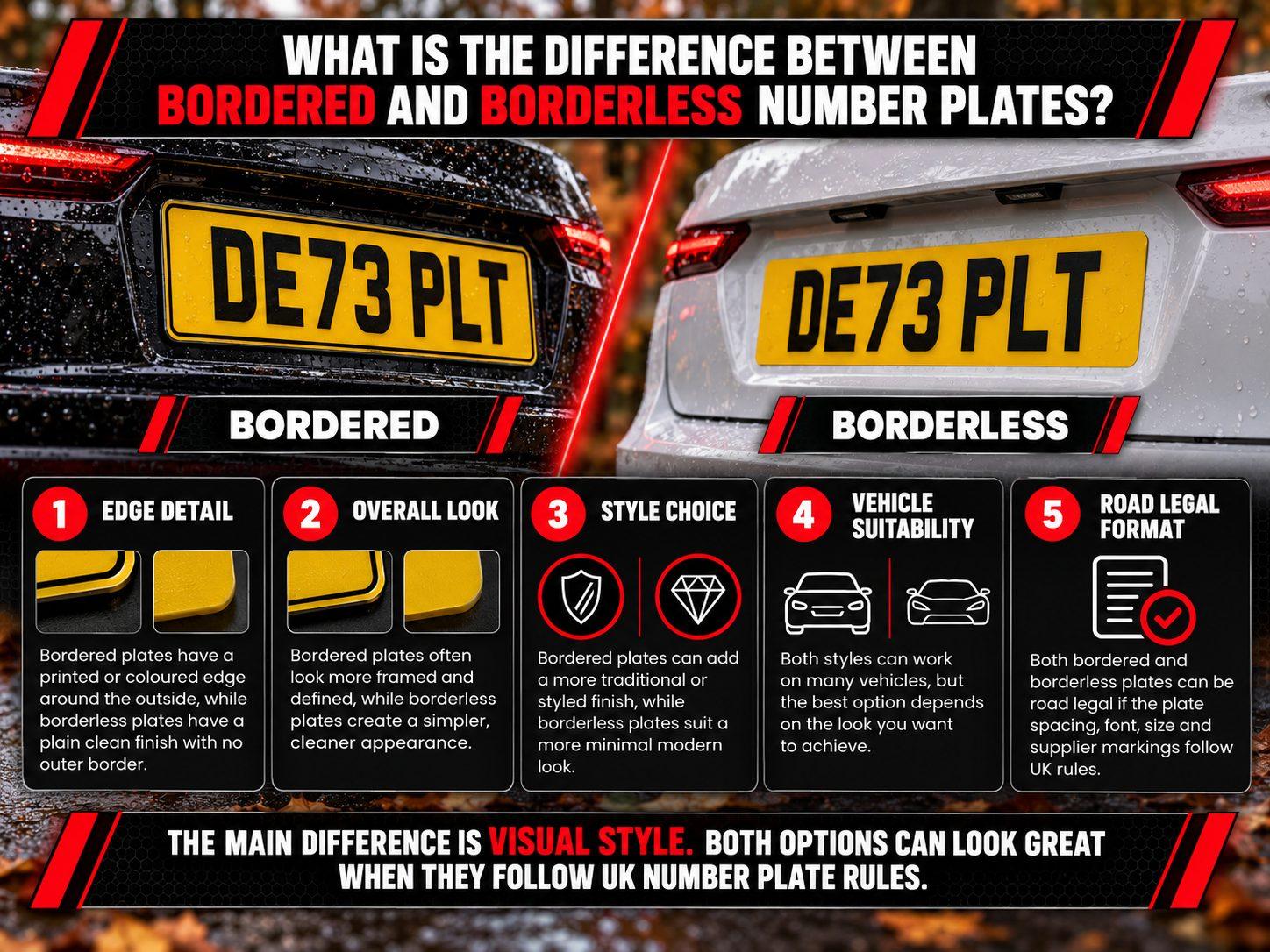
A bordered number plate has a visible line framing the registration area, while a borderless plate leaves uninterrupted background space around the characters. The registration remains the same, yet the presentation changes.
That extra line gives your eye another visual boundary. Remove it and the characters become the main feature against the reflective background.
This distinction is worth considering alongside the other types of number plate available. Character construction, spacing and other design details can influence the overall appearance just as much as the edge treatment.
If possible, compare the same registration with and without a border. Keeping the registration and character treatment identical makes it easier to judge the effect of the border itself.
Which Gives the Cleanest Overall Appearance?
Borderless plates usually create a cleaner, more minimal appearance because there is less visual detail around the registration. A border adds definition, giving the plate a more deliberately framed finish.
Consider the plate alongside the vehicle rather than on its own. A smooth bumper with restrained trim may suit an uninterrupted design, while pronounced trim or strong body lines can work well with a defined border.
The plate recess also matters. A deeply shaped recess already frames the registration, meaning another outline may add unnecessary detail. On flatter mounting areas, a border can provide more visual definition.
Our guide to choosing a number plate style covers other design considerations when matching plates to your vehicle.
Do Bordered or Borderless Plates Suit Modern Cars Better?
Borderless plates can complement modern cars with clean body lines and restrained exterior detailing. A border can work equally well where contrasting trim or a defined plate recess already creates strong visual boundaries.
Take a contemporary performance hatch with gloss-black trim around the rear. A dark border may visually relate to those existing details, depending on the complete plate design. On a car with a smooth tailgate and fewer contrasting elements, leaving the border off can keep attention on the registration itself.
There is no useful rule stating that every modern vehicle needs a borderless plate. Look at the rear or front of the car as one composition. The best treatment is the one that works with the lines already there rather than adding detail for its own sake.
What About Classic and Traditionally Styled Cars?
A border can complement traditionally styled vehicles by adding definition around the plate, particularly where the car already features pronounced trim. This is a styling consideration rather than a rule for classic vehicles.
Chrome bumpers, brightwork and strong horizontal lines can give an older design more visual structure. A framed registration may sit comfortably among those features. Equally, a particular vehicle may look better with fewer competing details.
Do not use appearance alone to decide what is legally suitable for a historic vehicle. Styling preference and the rules governing registration plates are separate considerations, especially where period-correct treatments are concerned.
How Do Borders Look With 3D and 4D Characters?
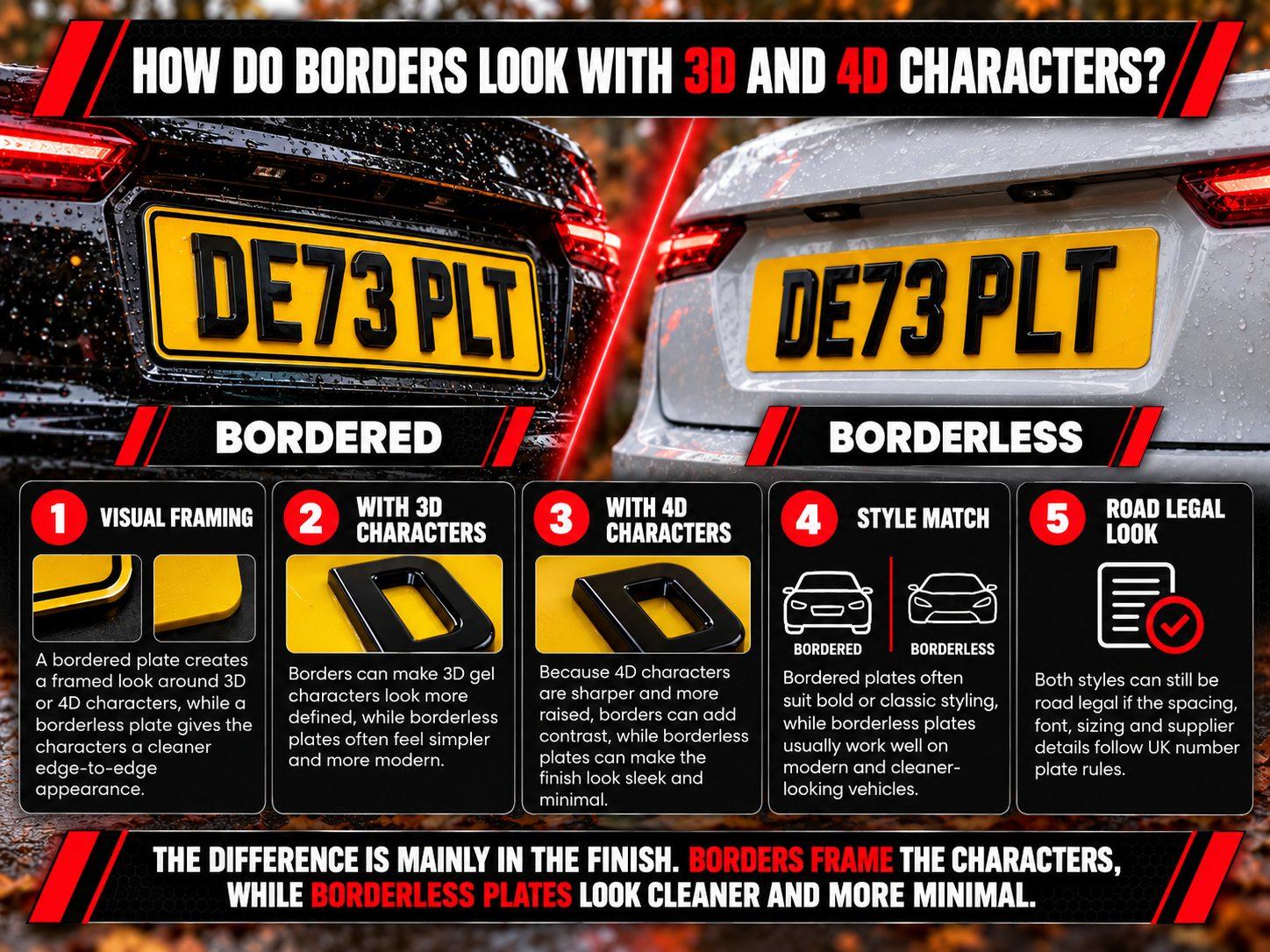
Raised characters already introduce depth and extra visual detail, meaning a border can noticeably change the balance of a 3D or 4D plate. A border creates another defined element, while a borderless treatment leaves greater visual emphasis on the lettering.
Consider the design in layers. You have the reflective background, registration characters and, potentially, raised character depth. Adding an outline creates another component for the eye to process.
If the raised lettering is intended to be the dominant feature, comparing it against an uninterrupted background is worthwhile. If you prefer stronger definition around the complete plate, compare the same character treatment with a border.
Avoid assuming every combination is available or suitable for road use. Exact compatibility depends on the plate specification and options being ordered.
Does a Border Affect Cleaning or Everyday Use?
For most drivers, border versus borderless should primarily be a styling decision rather than a cleaning one. Any meaningful maintenance difference depends on how the design is produced and the construction of the plate.
Whichever style you choose, keeping the registration clean and clearly visible matters more than the presence of an outline. Our guide on how to clean a number plate covers routine care in greater detail.
Are Borders on Number Plates Legal in the UK?
Yes. UK registration plates can have a border, provided it meets the applicable legal requirements for road use. The rules cover its width, position and appearance.
Under the current specification, an optional border must be permanently marked, non-retroreflecting and a single shade without a design, pattern or texture. It must sit at least 10 mm from the registration characters and measure no more than 5 mm wide.
Different requirements can apply to vehicles first used before 1 September 2021, making the relevant specification important when checking compliance.
Going borderless does not remove other road-use requirements. These cover areas including reflective material, background colours, registration characters, supplier markings and the applicable British Standard. Plates fitted after 1 September 2021 use BS AU 145e.
For further guidance on compliant plates, read our guide to number plate laws.
Bordered vs Borderless: Which Should You Choose?
Choose borderless if you prefer an uninterrupted background with less visual detail around the registration. Consider borders if you want a more defined edge or an outline that works with existing features on the vehicle.
Use these prompts when comparing your options:
If You Prefer… | Consider… |
A clean, minimal appearance | Borderless |
A clearly defined plate edge | Bordered |
Raised characters as the main visual feature | Compare both, starting with borderless |
A design that echoes surrounding trim | Consider bordered |
You cannot decide from the plate alone | Preview both complete designs |
Treat these as styling prompts rather than fixed rules. The shape of the plate recess, amount of exterior trim, character treatment and overall vehicle design can change the result.
Small details are easier to judge when you can compare the complete plate rather than imagine the finished effect. If you are still deciding, design your number plates with Demon Plates and compare the treatments alongside your chosen plate design.