



A modern number plate combines several materials and manufacturing processes. Its construction can include a rigid substrate, retroreflective background, registration characters, bonding methods and raised character components.
Understanding these number plate materials helps explain the physical differences between acrylic, aluminium, 3D gel, 4D and 5D plates. This guide looks at how each component works, how construction affects the finished appearance and durability, and what you need to consider when choosing a plate for your vehicle and intended use.
What Materials Are Modern Number Plates Made From?
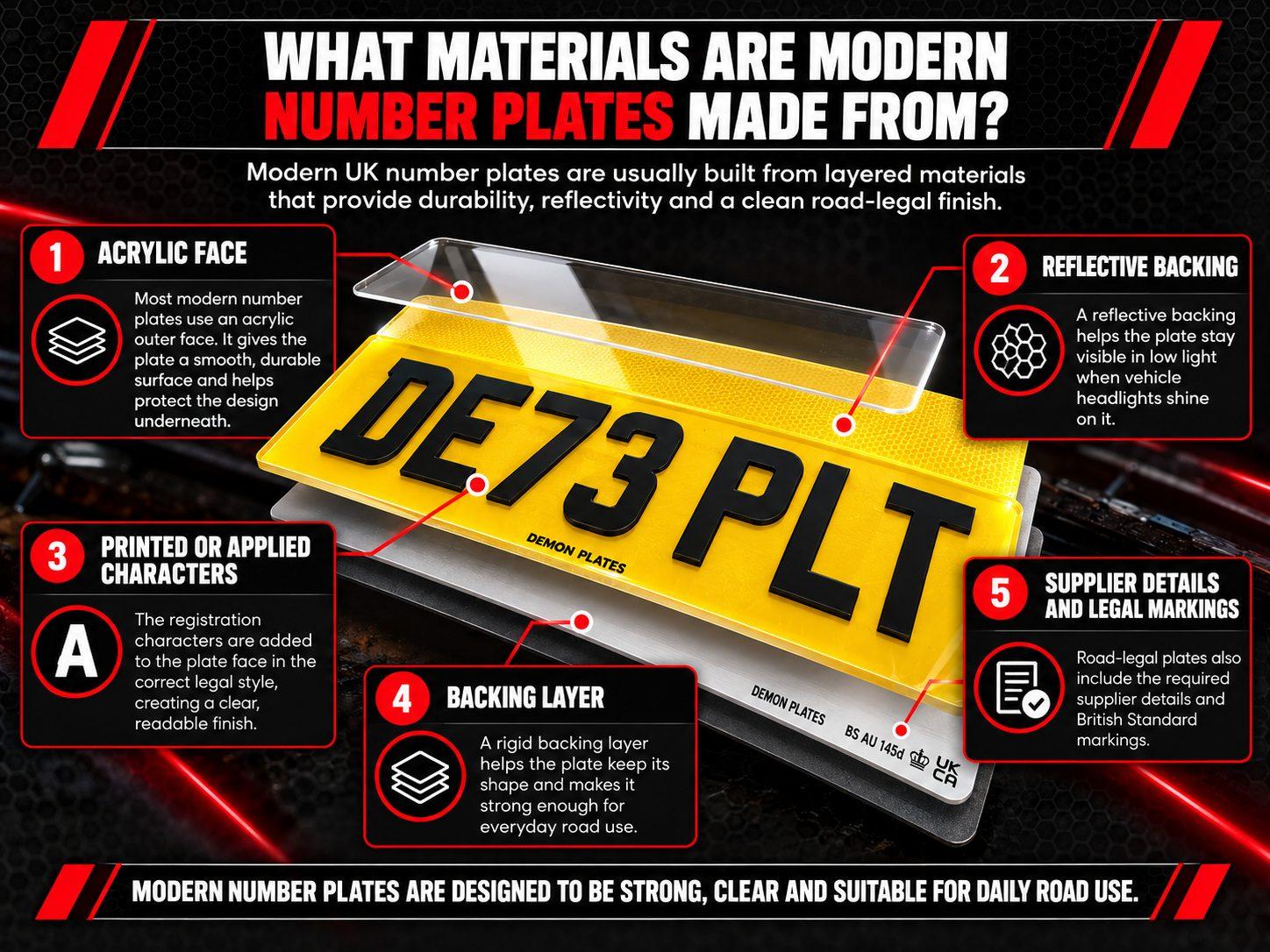
Modern number plates combine several components rather than relying on one material. Depending on the construction, these can include an acrylic or alternative substrate, retroreflective material, printed registration characters and additional gel or acrylic character layers.
Each component has a different job. The substrate provides structure, the reflective material creates the required background, and the characters display the registration. Raised designs introduce extra components to create physical depth.
These differences become important when comparing acrylic vs aluminium number plates, as the substrate and character construction can change the plate's profile and finish.
Acrylic sheets
Acrylic provides a rigid, clear surface suited to modern plate construction. Its exact role depends on the manufacturing method. The acrylic specification and thickness used by Demon Plates require verification.
Reflective material
Road-use plates require a reflective background, with white used at the front and yellow at the rear. This material helps the registration remain visible when illuminated, including when headlights reach a rear plate at night.
Printed characters
Printed characters create a flat registration without additional character depth. Demon Plates' exact printing technology, inks and production process require verification.
Raised gel and acrylic characters
Raised characters add physical depth to the registration. Gel-style characters provide a rounded profile, while solid acrylic layers can produce sharper edges. Terms such as 3D, 4D and 5D describe product styles rather than separate statutory manufacturing standards.
Why Is Acrylic Used for Number Plates?
Acrylic is widely used in modern number plate construction because it provides a rigid, clear surface that works well with reflective backgrounds and registration characters.
Its clarity helps present the registration cleanly, while its rigidity gives the finished plate structure. Acrylic can also support different plate constructions and character styles.
Material choice alone does not determine durability. Manufacturing quality, bonding, fitting, cleaning, impacts and environmental exposure can all affect a plate's condition. Aluminium provides an alternative construction with different characteristics, explored further in our guide to acrylic vs aluminium number plates.
How Does Reflective Number Plate Material Work?
UK road number plates use retroreflective material to return light towards its source, helping the registration remain visible under illumination while retaining the required white front and yellow rear backgrounds.
This differs from an ordinary glossy or brightly coloured surface. Retroreflection directs a useful proportion of incoming light back towards where it came from. A rear plate illuminated by headlights is an everyday example.
The distinction between background and characters is important. GOV.UK states road-use number plates must be made from reflective material, while the registration characters themselves must not be reflective. Plates fitted after 1 September 2021 must also use characters in a single shade of black. Raised 3D characters are permitted.
The precise reflective film manufacturer or specification used by Demon Plates requires verification. A road-legal claim should apply to the compliant finished plate, not be inferred merely because one component is reflective.
What Are Number Plate Characters Made From?
Registration characters can be created through printing or raised-character construction. The chosen method affects depth, edge definition and the overall appearance of the finished registration.
This is one of the clearest areas where plate terminology can confuse buyers. A character can look dimensional because a physical component sits above the plate surface. Older visual effects could also use shading, although plates fitted after 1 September 2021 require characters in a single shade of black.
Printed characters
Printed characters produce a flat registration surface. They suit drivers who want a conventional appearance without additional character depth.
Demon Plates' exact printing and assembly method requires verification, including the printing technology and stage at which the characters are incorporated into the plate.
Domed gel characters
Gel characters create a rounded raised profile. Their curved surface produces a visibly different finish from both flat printing and hard-edged dimensional characters.
The material formulation, production method, bonding process and character depth used by Demon Plates require verification. These details should be added from workshop information rather than assumed from the term "gel".
Laser-cut acrylic characters
Solid acrylic character components can create a more defined dimensional profile. Where laser cutting is used, the characters are cut to shape before being positioned as part of the plate construction.
Whether this describes Demon Plates' precise process, along with acrylic specification, character thickness and attachment method, requires verification.
Layered characters
Combining character components can create a deeper or more complex profile. This is where commercial descriptions such as "5D" need careful explanation.
A buyer should be shown the physical layers rather than asked to assume 5D represents a legally defined category above 4D. Demon Plates' precise 5D construction requires verification.
How Are Standard Number Plates Manufactured?
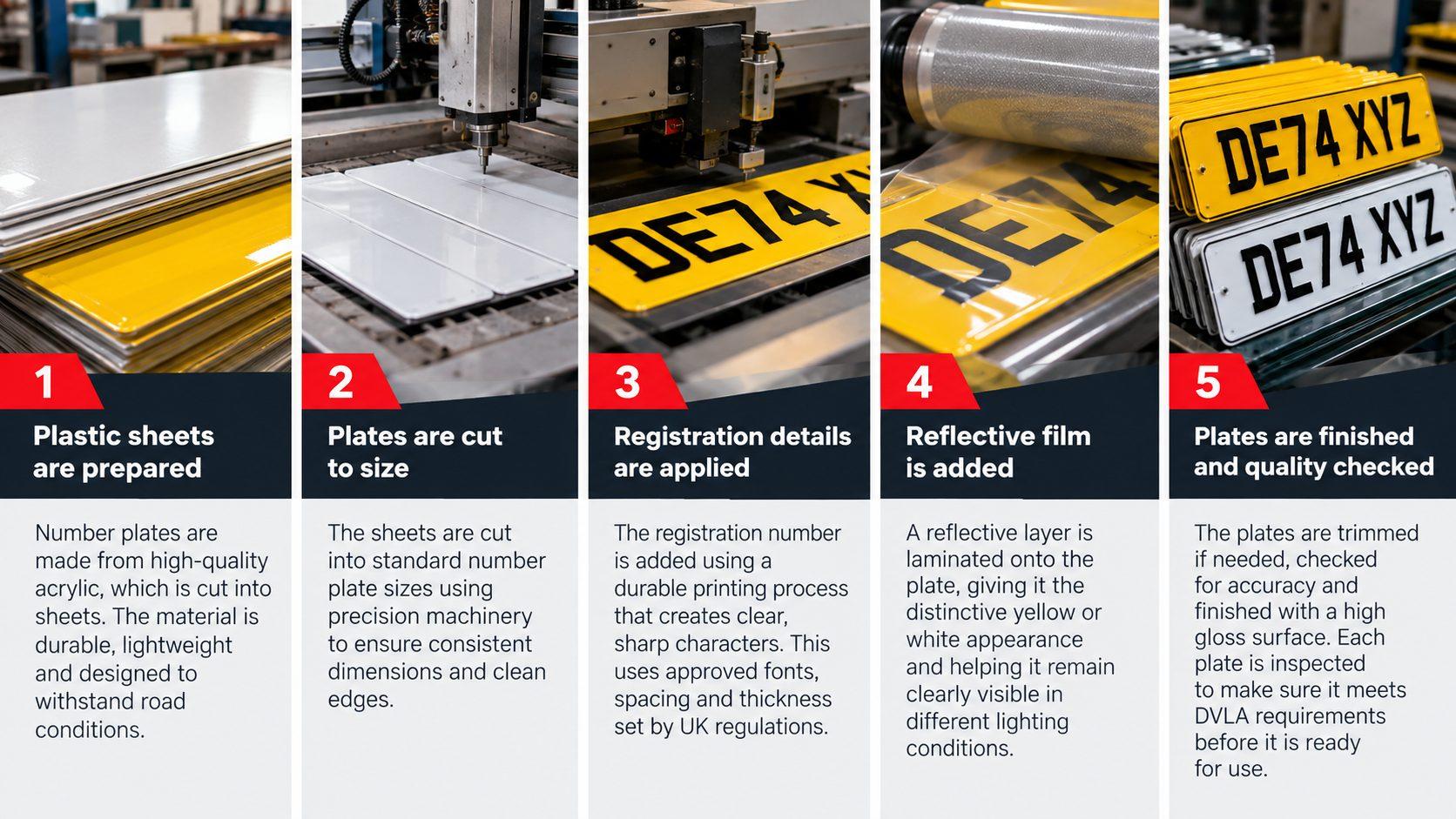
A standard number plate is produced through a sequence that brings together the registration design, characters, reflective material and plate components before cutting, finishing and inspection. Demon Plates' exact workshop sequence requires verification, so the stages below describe the process without assuming unconfirmed production methods.
Creating the Number Plate Design
Production begins with preparing the registration in the required layout. Road-use plates must follow the applicable rules for character positioning, spacing and presentation rather than altering the registration for visual effect.
Producing the Registration Characters
The characters are created using the method appropriate to the plate. Standard printed and raised-character products may require different processes. Demon Plates' exact production methods require verification.
Applying the Reflective Material
Road-use plates require a reflective background. How Demon Plates apply or incorporate this material within its plate assembly requires verification.
Bonding the Plate Layers
The relevant components are brought together to form the plate. The precise Demon Plates bonding, adhesive or lamination process requires verification rather than being inferred from industry methods.
Cutting and Finishing
The assembled plate is cut to its finished dimensions and the edges completed. Specific machinery, tolerances and finishing techniques require workshop confirmation. Learn more about how number plates are made.
Inspecting the Finished Plate
The completed plate should be checked for registration accuracy, alignment, surface condition, finish and required markings. Demon Plates' exact quality-control procedure requires verification before describing these checks as its confirmed manufacturing process.
How Are 3D Gel Number Plates Manufactured?
3D gel plates create their raised appearance through dimensional characters rather than relying solely on a flat registration surface. The rounded profile is the important physical difference for a buyer comparing finishes.
The exact Demon Plates manufacturing sequence, gel material, character production method, attachment process and depth require verification.
From a buying perspective, focus on what can be seen and checked. Gel characters should be compared by their rounded profile, positioning and relationship with the rest of the plate rather than by the "3D" label alone.
Drivers considering this finish can explore Demon Plates' 3D number plates. If the choice is between dimensional styles, the 3D vs 4D number plates comparison provides a more useful next step than assuming one format is automatically superior.
How Are 4D Number Plates Manufactured?
4D number plates use raised character elements with a more defined dimensional profile than a conventional flat printed plate. "4D" describes a product style rather than a separate statutory manufacturing category.
A proper manufacturing explanation needs to identify the character material, cutting process, depth, bonding method and positioning. Those Demon Plates-specific details require verification.
For the customer, edge definition is one of the most useful visual differences to examine. A side-profile photograph can reveal far more than a front-facing product name because it shows how far the characters project and how their shape differs from a domed gel finish.
Explore the available 4D number plates when comparing this sharper raised appearance with other constructions.
How Are 5D Number Plates Manufactured?
"5D" should be understood through the materials and character layers used in the product, not as a universally defined number plate manufacturing standard.
This makes a cross-section particularly valuable. It can show whether the visual depth comes from combining different character components, how those components relate to the base plate and what separates the product from 3D or 4D alternatives.
Demon Plates' exact layering, materials, character depths and bonding process require verification before those details can be stated.
When reviewing 5D number plates, judge the visible construction and finish rather than treating the number in the product name as a measure of legal status or objective quality.
How Are Prism Number Plates Manufactured?
Prism plates create a distinctive visual treatment through their character or surface construction. The exact Demon Plates method needs to be described from first-hand manufacturing information rather than inferred from the product name.
The materials, layering, surface finish, production stages and interaction with light all require verification.
A close-up photograph under consistent lighting would give buyers useful evidence of how the effect differs from conventional raised characters. For more product context, see prism number plates explained.
How Are Pressed Metal Number Plates Manufactured?
Pressed metal plates use a fundamentally different construction from a typical modern acrylic plate because their form is created through metal-working rather than acrylic layering.
Pressing can create raised registration characters or shaped areas directly in the metal construction. This gives the plate a different side profile and material character from an acrylic assembly with separate raised elements.
Whether pressed metal plates form part of Demon Plates' current product range requires verification. Without confirmation, they are best treated here as useful context when comparing aluminium and acrylic plate construction.
How Do Number Plate Materials Affect Appearance?
Materials influence depth, edge definition, surface finish and the prominence of the registration characters. Two compliant plates can therefore present the same registration with noticeably different visual characteristics.
A flat printed plate keeps the registration on one visual plane. Domed characters add rounded depth. Solid raised components can create harder edges and a more architectural profile. Layered constructions can increase the visual separation between the registration and background.
Vehicle styling matters too. A restrained standard plate may suit someone seeking a conventional factory-style appearance. An enthusiast looking for stronger character definition may prefer a raised design.
The useful question is not "Which style is best?" It is "Which construction gives the finish I want while meeting the requirements for how I intend to use it?"
The Demon Plates guide to choosing the right number plate style can help narrow the options.
How Do Materials Affect Number Plate Durability?
A plate's durability depends on the compatibility of its materials, bonding, manufacture, fitting, cleaning and exposure to road conditions. Material names alone do not provide a reliable lifespan prediction.
Sunlight and fading
Long-term sunlight exposes plate components to ultraviolet radiation. Claims about UV resistance or expected service life need product-specific evidence, so no lifespan should be assumed from acrylic, gel or another material name.
Water and temperature changes
A vehicle plate faces rain, washing, road spray and changing temperatures. Construction quality becomes particularly relevant where several layers or attached components meet.
Cracking and delamination
Impact can damage a rigid plate, while failure between bonded components can appear as lifting or separation. Delamination can also affect the plate's appearance and readability.
Security of raised-characters
Raised components introduce an attachment interface absent from a purely flat printed finish. Their security depends on the verified product construction and bonding method.
If an existing plate is deteriorating, the guide to why number plates fade, crack or peel explains the warning signs worth checking.
What Manufacturing Defects Can Affect Number Plates?
Misalignment, poor bonding, damaged surfaces, lifting components and incorrect finishing can affect a plate's appearance or serviceability. The relevant defects vary with the construction method.
A practical inspection should look for:
registration characters positioned consistently;
clean surfaces without obvious production damage;
raised components sitting securely and evenly;
no visible lifting between bonded layers;
cleanly finished edges;
correct registration details and mandatory markings on road-use plates.
These points should not be presented as Demon Plates' internal quality-control procedure until the workshop process has been verified.
Which Standards Must Number Plate Materials Meet?
New and replacement UK road plates fitted after 1 September 2021 must meet the applicable BS AU 145e requirements, alongside rules governing the background, characters and mandatory markings.
Current GOV.UK guidance requires reflective material, black characters on a white front background and black characters on a yellow rear background. Plates must show the supplier and relevant British Standard marking. Characters cannot be removable or reflective.
The underlying regulations specify retroreflecting material compliant with BS AU 145e, or a recognised equivalent offering equivalent performance, for the applicable plates.
Compliance concerns the finished road-use plate, not one component viewed in isolation. Buying acrylic, reflective material or raised characters does not independently establish road legality.
Registration layout matters as well. Characters must not be rearranged or altered to make them difficult to read. An incorrectly displayed registration can lead to an MOT failure and a fine of up to £1,000.
Road-use plates must also come from a registered number plate supplier. The supplier needs original documents proving identity and entitlement to the registration.
How Are Number Plates Tested for Quality?
Road-use plate standards assess more than appearance. Relevant requirements concern characteristics such as visibility, strength and reflectivity, while production checks can assess whether an individual finished plate has been assembled, marked and finished correctly.
These are two different levels of assurance.
Standards compliance concerns the requirements applying to the plate construction and its performance.
Production inspection concerns the individual plate leaving the manufacturing process. Checks might cover registration accuracy, positioning, surface condition and required markings, although Demon Plates' exact inspection procedure requires verification.
This distinction matters because a visual check in a workshop is not the same as formal testing against a British Standard. The two should never be presented as interchangeable.
Can Old Number Plate Materials Be Recycled?
Whether an old number plate can be recycled depends on its complete construction and the facilities available locally, especially where different materials have been permanently bonded together.
A metal plate may follow a different disposal route from an acrylic construction. Mixed assemblies can be harder to process where the substrate, reflective layer, adhesive and character components cannot readily be separated.
Check the materials first, then consult the recycling guidance offered by your local authority or waste facility. Do not place a plate in a recycling stream solely because one component is technically recyclable.
Demon Plates-specific recyclability claims require verification of the complete product composition and a realistic UK disposal route.
Before disposing of an old registration plate, consider making the registration unreadable to reduce the risk of misuse.
How Should You Choose Between Different Number Plate Materials?
Choose a plate by considering intended use, compliance, character style, appearance, construction and budget rather than assuming one material or product label is universally better.
Priority | What to Compare |
Conventional appearance | Standard flat construction |
Rounded raises effect | Verified 3D gel construction |
Sharper dimensional profile | Verified 4D construction |
Deeper layered appearance | Demon Plates’ verified 5D construction |
Different substrate preference | Acrylic and aluminium options |
Public-road use | Applicable display rules and BS AU 145e compliance |
Replacement plate | Readability, condition, fitment and correct documents |
Budget | Current options and construction rather than assumptions based on product names |
For a daily-driven vehicle, start with road use. Check whether the specific finished product is intended and compliant for public-road display, then compare the appearance you want. A show plate or other non-road product should not be treated as road legal simply because its dimensions or materials resemble a compliant registration plate.
Next, look at the character profile. Choose between flat, rounded or sharper raised finishes according to the appearance you prefer. Then consider fitting and maintenance. Correct positioning, secure fixings and sensible cleaning all contribute to keeping the finished plate presentable and readable.
Finally, compare the construction rather than relying on labels. "3D", "4D" and "5D" can help identify product families, yet the physical materials and layers tell you far more about what you are buying.
Once you know which finish suits your vehicle and intended use, you can build your number plate and compare the available Demon Plates options.