



Choosing number plates for German cars should start with the vehicle itself. A factory-spec Mercedes-Benz E-Class, modified Golf GTI and current BMW M car each have a distinct visual character, meaning the same plate treatment will not suit every model.
The aim is to find a plate which complements the car rather than competes with it. Consider its age, trim, modifications and whether you prefer an understated OEM-style finish or a more noticeable part of the overall build.
Start With the Car, Not the Number Plate
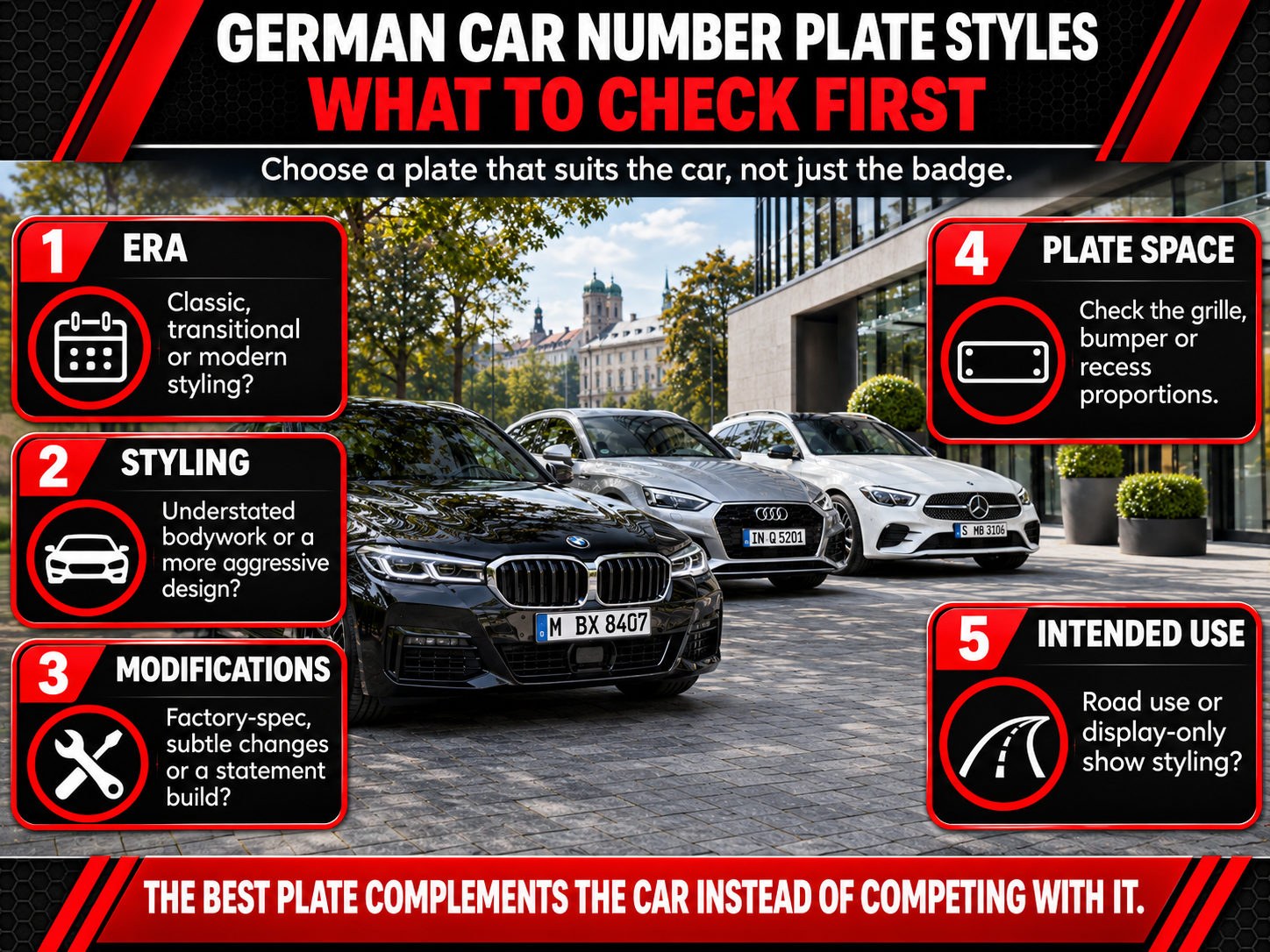
The best plate style depends more on your car's age, styling and level of modification than the badge on the bonnet. A restrained executive model can call for a different approach from a modified performance car.
Before comparing plate types, look at five aspects of your vehicle:
Era: Does the car have classic, transitional or contemporary styling?
Styling: Are its lines understated or deliberately aggressive?
Modifications: Is it factory specification, lightly modified or built to make a statement?
Plate space: How does the registration sit within the grille, bumper or rear recess?
Intended use: Will the plate be used on the road or solely for display?
Body colour and surrounding trim matter too. Gloss-black details, large grilles and angular bumpers can carry more visual depth. Restrained bodywork may look better with fewer competing details.
Our guide to choosing the right number plate style explores these decisions in more detail.
Standard Acrylic Plates for a Clean OEM-Style Look
Standard acrylic plates suit German cars where a clean, understated appearance matters more than added character depth. They work particularly well on factory-spec models where the registration should complement the styling rather than dominate it.
Consider a Mercedes-Benz E-Class, BMW 5 Series or Audi A6. Each already has distinctive design details without needing a prominent plate treatment.
Standard plates are not merely a default choice. For an unmodified car, their restraint can create a more cohesive OEM-style finish.
3D Gel Plates for Subtle Extra Depth
3D gel plates suit German cars where you want extra character without a sharper raised acrylic appearance. Their rounded profile can complement a daily-driven BMW, Audi or Volkswagen with restrained cosmetic modifications.
On a factory-spec executive or classic car, extra depth may feel unnecessary. Our guide to 3D vs 4D number plates explains the visual differences between both options.
Explore 3D number plates if this balanced styling approach suits your car.
4D Plates for Modern and Modified German Cars
4D plates can complement modern or modified German cars with angular styling, dark trim and defined exterior details. Their sharper raised appearance can work well with BMW M-inspired builds, Audi S or RS styling, and modified Golf GTI or R models.
Balance still matters. Strong plate depth can make an already detailed front end feel crowded, especially alongside badges, splitters and contrasting trim.
Browse 4D number plates if this more defined treatment suits your car.
5D Plates for a More Layered Appearance
5D plates suit German cars where the registration is intended to become a noticeable styling detail. Their layered appearance can complement heavily modified BMW, Volkswagen or Audi builds where other exterior features already depart from factory specification.
For an understated executive model, greater visual depth may compete with the cleaner appearance you want to preserve. Consider the plate alongside the entire vehicle rather than viewing it alone.
Explore 5D number plates if this statement-led approach suits your build.
Where Do Prism Plates Fit?
Prism plates suit German cars where the registration is intended to contribute to the build rather than remain understated. They sit towards the statement end of the styling spectrum, making them more appropriate for show-oriented performance cars with coordinated exterior modifications.
Visual balance remains important. When wheels, trim, aero parts and the plate all compete for attention, the overall appearance can become cluttered. Prism styling works best when it forms part of a considered theme rather than an isolated addition.
Can Short Number Plates Improve the Look of a German Car?
A shorter plate can reduce unused space when the registration and applicable dimensions allow it. This can create better proportions around a German car’s grille, bumper or plate recess.
A short personalised registration may suit a performance BMW, for example. However, characters cannot be compressed or respaced simply to achieve a smaller plate. UK rules still govern character dimensions, spacing and margins, meaning the plate must remain compliant when intended for road use.
Bordered or Borderless for German Cars?
Borderless plates create a cleaner edge, while a restrained border can give the registration more definition. The right choice depends on the trim and details surrounding the plate.
A borderless design can complement a modern Audi with crisp, minimal styling. A subtle border may suit cars with more traditionally framed details.
For road use, borders must meet applicable requirements covering their construction, width and position. Styling preference should never override the rules governing a compliant registration plate.
When Do Pressed Metal Plates Suit German Cars?
Pressed-metal styling makes the most visual sense when it supports a period-inspired or retro theme, rather than merely because the vehicle comes from Germany.
A classic Volkswagen or older Mercedes-Benz presents a very different design context from a new Audi. Material and era need to work together.
For road use, check the specific plate configuration and applicable requirements before ordering. Do not assume a pressed construction is suitable for public-road use based on appearance alone.
When Should You Use Custom Show Plates?
Custom show plates suit stationary display settings where branding, a build name or another presentation detail replaces a standard registration. They can work well on modified German cars at shows, club stands or photoshoots.
Show plates are not interchangeable with road-use number plates. Before driving on public roads, the vehicle must display its assigned registration correctly on compliant plates. Keep show styling for display purposes, then refit the appropriate road plates before leaving the event or location.
Which Plate Styles Suit BMW, Audi, Mercedes-Benz and Volkswagen?
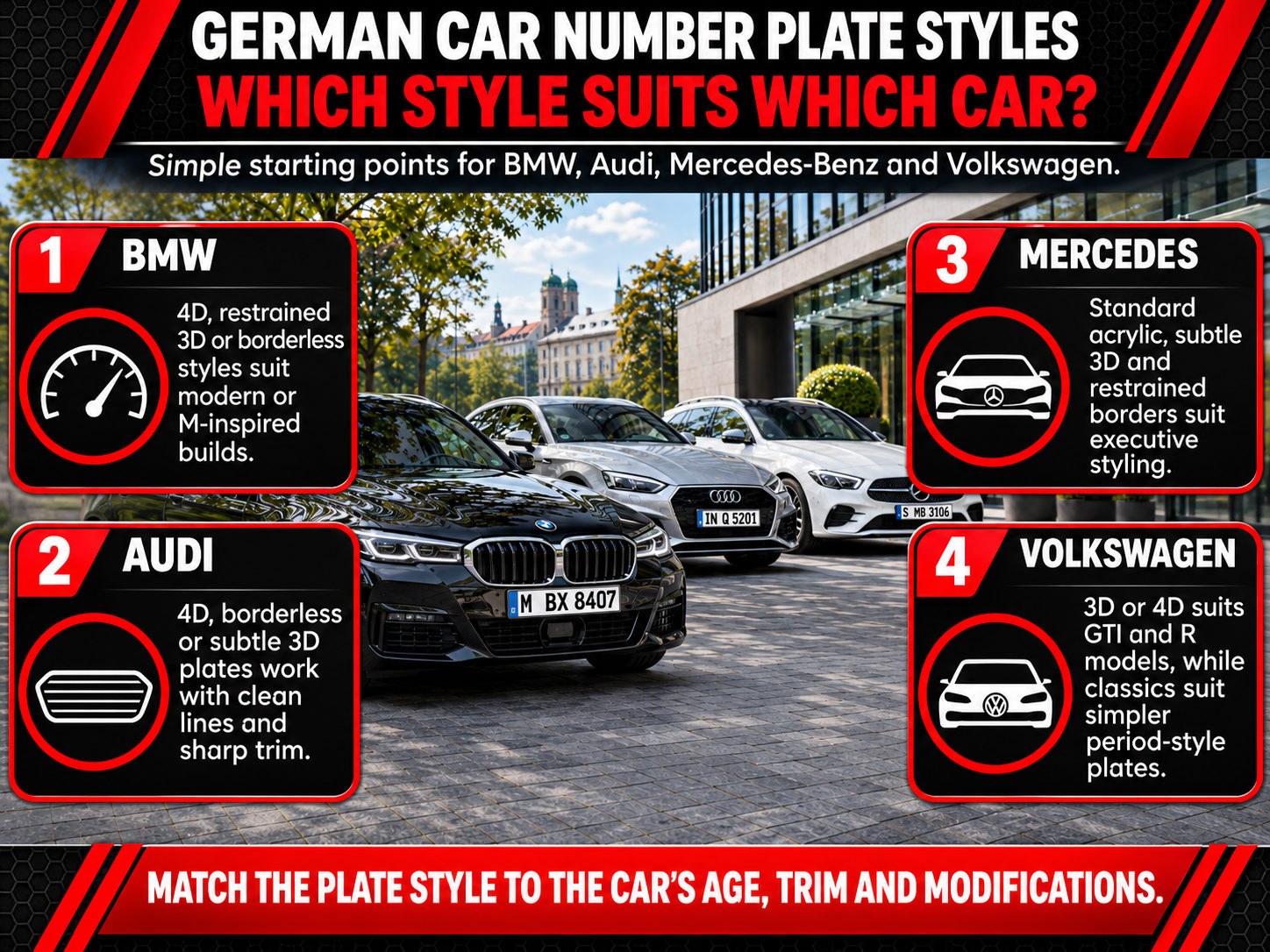
Brand can provide useful styling cues, although the model, generation, trim and modifications should make the final decision. These starting points reflect Demon Plates styling guidance, not fixed rules for every vehicle.
Vehicle or build | Styles to consider | Styling rationale |
Modern BMW or M-inspired build | 4D, restrained 3D, borderless | Defined details can complement a stronger, more angular front end |
Standard executive BMW | Standard, subtle 3D | Keeps the registration from dominating restrained bodywork |
Modern Audi or S/RS-inspired build | 4D, borderless, subtle 3D | Pairs with clean surfaces and sharper trim |
Mercedes-Benz executive model | Standard, subtle 3D, restrained border | Maintains a quieter factory-style presentation |
AMG-inspired build | 3D or 4D | Adds character depth where stronger exterior details already exist |
Modified Golf GTI/R | 3D, 4D or selected statement styles | Gives more scope where the vehicle already carries enthusiast modifications |
Classic Mercedes-Benz or Volkswagen | Standard or period-inspired treatment | Keeps the plate visually sympathetic to the car's era |
Show-oriented German build | 5D, prism or custom show plate | Makes the registration or display plate part of the presentation |
For a deeper model-specific comparison, explore our guide to number plate styles for BMWs.
You can also browse BMW number plates, Audi number plates, Mercedes number plates and Volkswagen number plates when comparing options for your car.
How to Choose the Right Plate for Your German Car
Start by deciding whether the registration should blend into the car or become part of its styling. Then narrow the choice using the vehicle's era, modifications, registration length and intended use.
Choose your direction. Decide between restrained OEM-style presentation and a more noticeable modified look.
Consider the era. A treatment which suits a current performance model may feel misplaced on a classic car.
Choose the character style. Compare flat characters with rounded or more sharply defined raised alternatives.
Assess the proportions. Look at the registration length, surrounding plate space and whether a border improves or distracts from the design.
Check road-use requirements. Confirm the finished configuration complies with the rules applicable to your vehicle before fitting it for public-road use.
The strongest choice is rarely the plate with the most visual impact. It is the one which feels considered alongside the grille, bumper, trim and overall character of the vehicle.
Whether your preference is an understated factory-style finish or more noticeable raised characters, compare Demon Plates' options and choose a plate which works with your German car rather than competing with it.