



UK tractor number plate rules differ from the requirements most drivers know from cars. A tractor used on public roads must display its assigned registration correctly, although agricultural machines have specific rules covering plate position, character dimensions and towing situations.
This matters when replacing an old plate or choosing one for a newly registered tractor. Before ordering, check the registration, where the plate will be mounted and which requirements apply to your vehicle.
Does a Tractor Need a Number Plate?
A tractor registered for road use needs an assigned registration and must display it in line with the rules for agricultural machines. New and used tractors requiring registration are registered with the DVLA.
The key distinction is road use. A working tractor travelling between fields on public roads needs to meet the relevant registration requirements. You should not assume every agricultural machine used solely on private land falls into the same situation.
Once you know the registration and required configuration, you can consider suitable tractor number plates.
Where Does the Number Plate Need to Be Fitted on a Tractor?
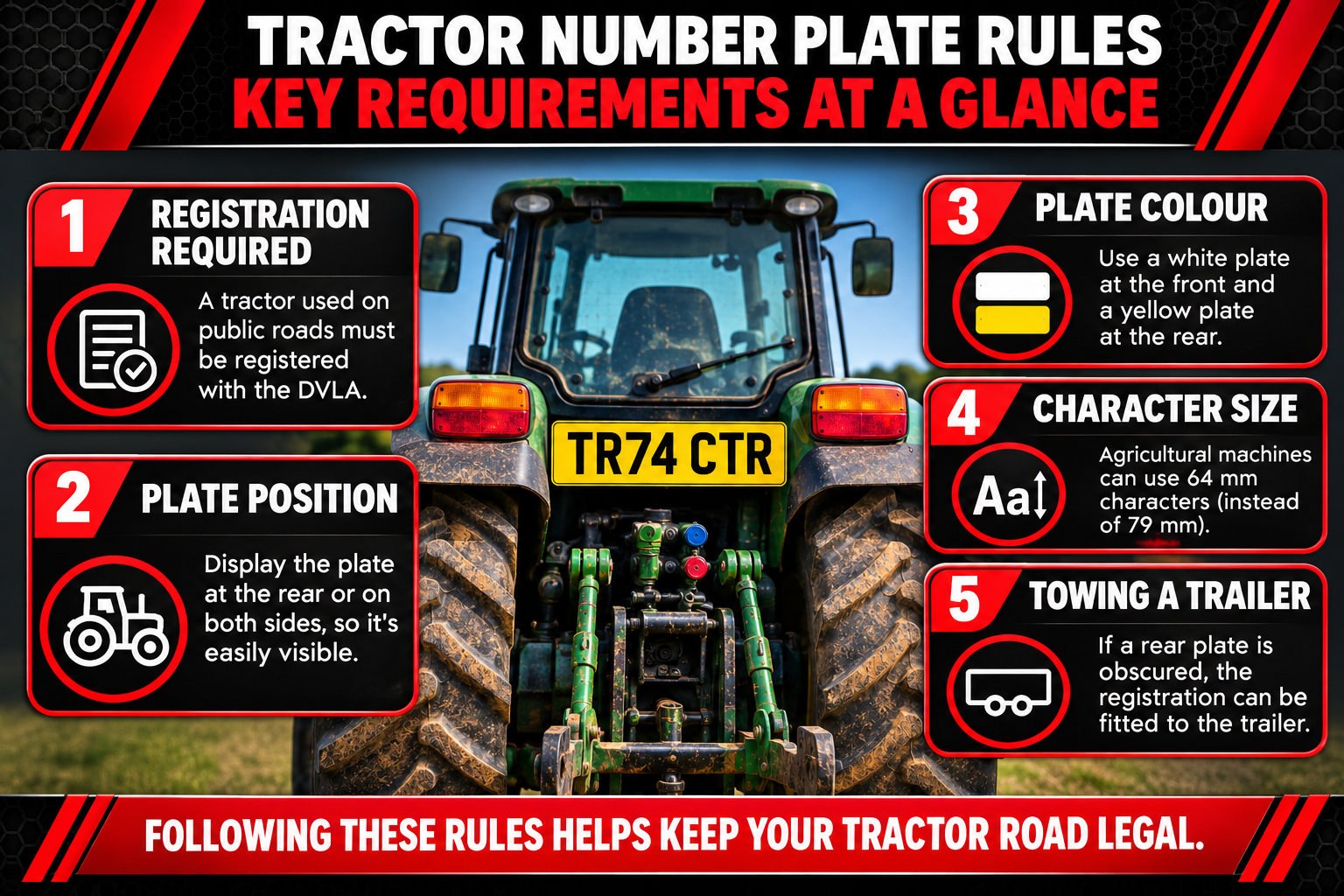
Agricultural machines do not follow the standard car arrangement of separate front and rear plates. Regulation 8 allows the registration to be displayed on both sides of the tractor or at the rear, provided it is easily distinguishable from the required direction.
Side-mounted plates must allow the registration to be distinguished from either side. A rear-mounted plate must be distinguishable from behind. The plate should also be vertical, or as close to vertical as reasonably practicable.
This flexibility helps tractors with limited conventional mounting space. However, rear implements, brackets or other equipment must not prevent the registration from being clearly distinguished.
Before fitting a replacement, check the available mounting area and viewing position rather than copying an unsuitable existing setup. See our number plate fitting guidance for further installation advice.
What Happens to the Number Plate When a Tractor Tows a Trailer?
When an agricultural machine tows a trailer and its registration plate is not fixed on the tractor's sides, the plate can be fixed to the trailer. If more than one trailer is being towed, it can be fitted to the rearmost trailer. The registration must remain easily distinguishable from behind.
This is particularly relevant when a trailer or implement obscures a rear-mounted tractor registration.
Regulation 8 also contains a specific agricultural provision allowing a plate fixed to the trailer to display the registration mark of another agricultural machine kept by the keeper of the towing vehicle.
What Colour Should Tractor Number Plates Be?
Current road-use plates generally use black characters on a white reflective background at the front and black characters on a yellow reflective background at the rear. Historic vehicles can be subject to different provisions.
Agricultural machines need extra care here because their permitted positioning differs from the familiar front-and-rear arrangement used on cars. Avoid choosing a plate purely from its appearance or where it happens to fit.
For more background on the different formats you may encounter, read our guide to number plate colours.
What Font and Character Size Can a Tractor Number Plate Use?
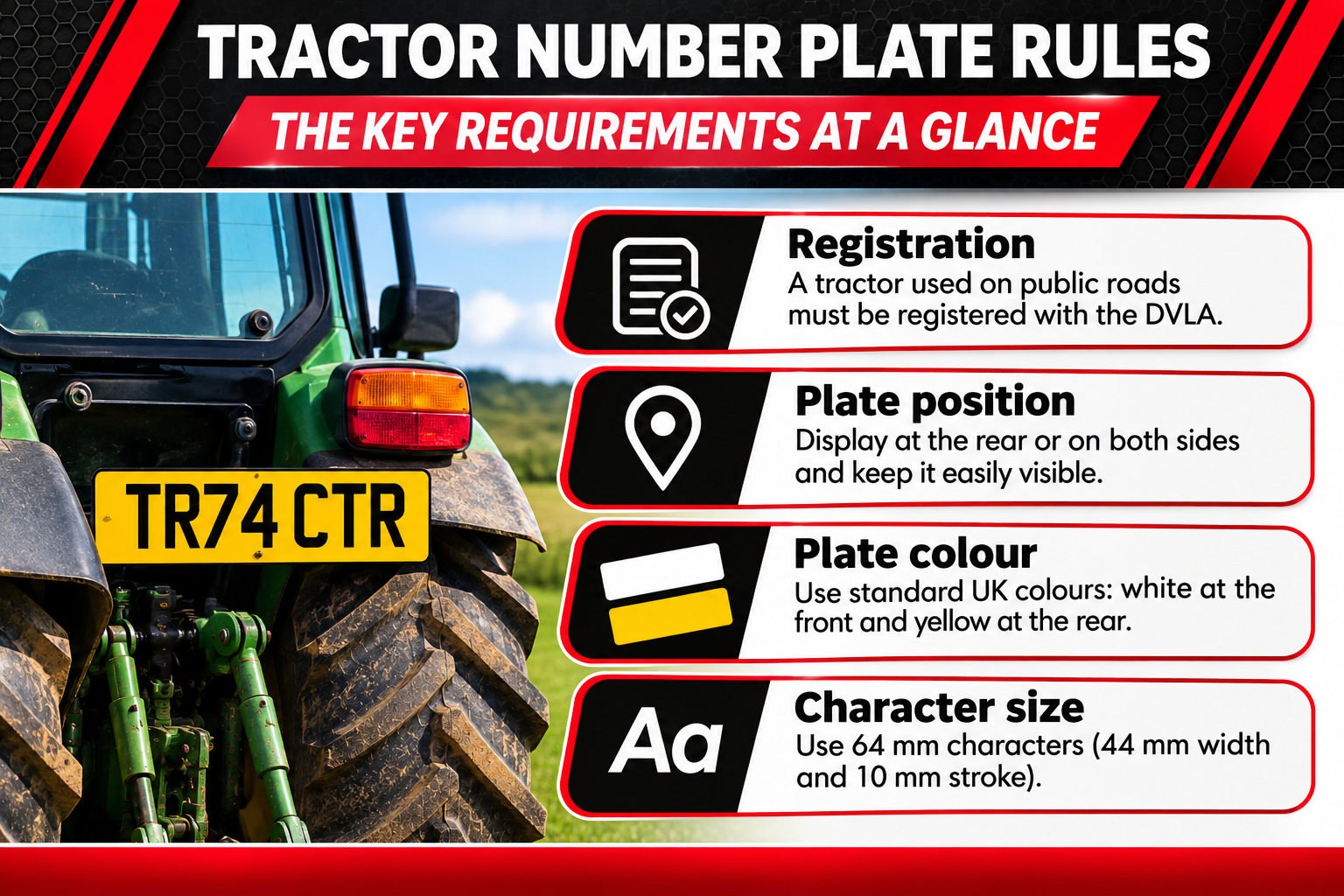
Agricultural machines have a specific provision allowing registration characters to be 64 mm high. This differs from the standard 79 mm character height applied in many other cases.
For 64 mm characters, the regulations specify a character width of 44 mm, apart from the letter I and number 1, with a 10 mm stroke width. Other prescribed dimensions apply to spacing and margins.
The important point is not to shrink an ordinary layout until it fits an awkward mounting space. The finished registration still has to follow the applicable statutory dimensions and prescribed character style.
Our guide to legal number plate fonts explains the wider typography requirements.
How Should the Characters Be Spaced?
Registration characters must follow the prescribed spacing rather than being moved around to suit the available mounting area. For the 64 mm agricultural-machine character provision, Table B specifies 10 mm between characters within a group and 30 mm horizontally between groups.
A restricted mounting area does not give an owner permission to compress, rearrange or misrepresent a registration.
Check the complete registration before choosing a plate format. A long registration may require a different practical solution from a short one.
What Size Number Plate Does a Tractor Need?
There is no single overall width and height suitable for every tractor registration. The required plate dimensions depend on the characters, prescribed spacing, margins, layout and registration being displayed.
This distinction matters when measuring a mounting area. A plate being physically small enough to fit does not establish whether its registration layout complies with the rules.
Measure the available space, then consider the full registration and its applicable character configuration. Our number plate size guide provides further guidance on plate dimensions.
What Markings Must a Tractor Number Plate Include?
Current road-use number plates need the markings required under the applicable specification. GOV.UK states plates must show who supplied them and carry the relevant British Standard number. Plates fitted after 1 September 2021 use BS AU 145e.
These details form part of the plate specification rather than optional decoration. When replacing an older tractor plate, do not copy an existing plate blindly. Its age, condition or specification may differ from the requirements applying to a new replacement.
Does a Tractor Number Plate Need to Be Clearly Visible?
Yes. A tractor registration must be easily distinguishable from the direction required by its mounting position. The agricultural-machine rules make visibility part of the positioning requirement.
Farm use creates practical issues worth checking before entering a public road. Look for mud covering characters, an implement obscuring a rear plate, damage around mounting points or a plate sitting at an unsuitable angle.
Cleaning the plate before road use can solve dirt-related visibility problems. Physical damage or poor positioning needs a more permanent solution.
When Should a Tractor Number Plate Be Replaced?
Replace a tractor plate when damage or deterioration prevents the registration from being displayed correctly or makes it difficult to distinguish.
Check for:
cracks through or around the characters
missing sections
damaged or deteriorated reflective material
damaged characters
insecure mounting
deterioration affecting readability
A minor cosmetic mark does not automatically mean a new plate is required. Focus on whether the registration remains correctly displayed and readable.
Where replacement is needed, check the registration and mounting arrangement before ordering replacement number plates.
What Are the Number Plate Rules for Historic Tractors?
Some historic tractors may qualify to display traditional black plates with light-coloured characters. Age alone does not establish eligibility, and restoration style does not override registration requirements.
Current DVLA guidance permits traditional plates for qualifying vehicles manufactured before 1 January 1980 where the relevant historic-vehicle conditions are met. Owners restoring an older tractor should check its registration and historic status before choosing a period-style plate.
This is particularly important when originality is part of a restoration. A plate may look appropriate for the tractor's age without meeting the requirements for road use.
Tractor Number Plate Rules: Quick Checklist
Before taking a registered tractor onto a public road, check its registration is displayed in the correct position, remains legible and uses an appropriate plate specification.
Confirm the tractor is correctly registered for road use.
Check the correct registration mark is displayed.
Confirm the plate position follows the agricultural-machine rules.
When towing, make sure the registration remains correctly displayed from behind where required.
Check the characters, layout and spacing.
Remove mud or dirt affecting readability.
Check a current replacement carries the appropriate supplier and British Standard markings.
Replace a damaged or unsuitable plate before relying on it for road use.
Need to replace a damaged or unsuitable plate? Explore Demon Plates' tractor number plates once you have confirmed the registration, mounting position and plate format you require.